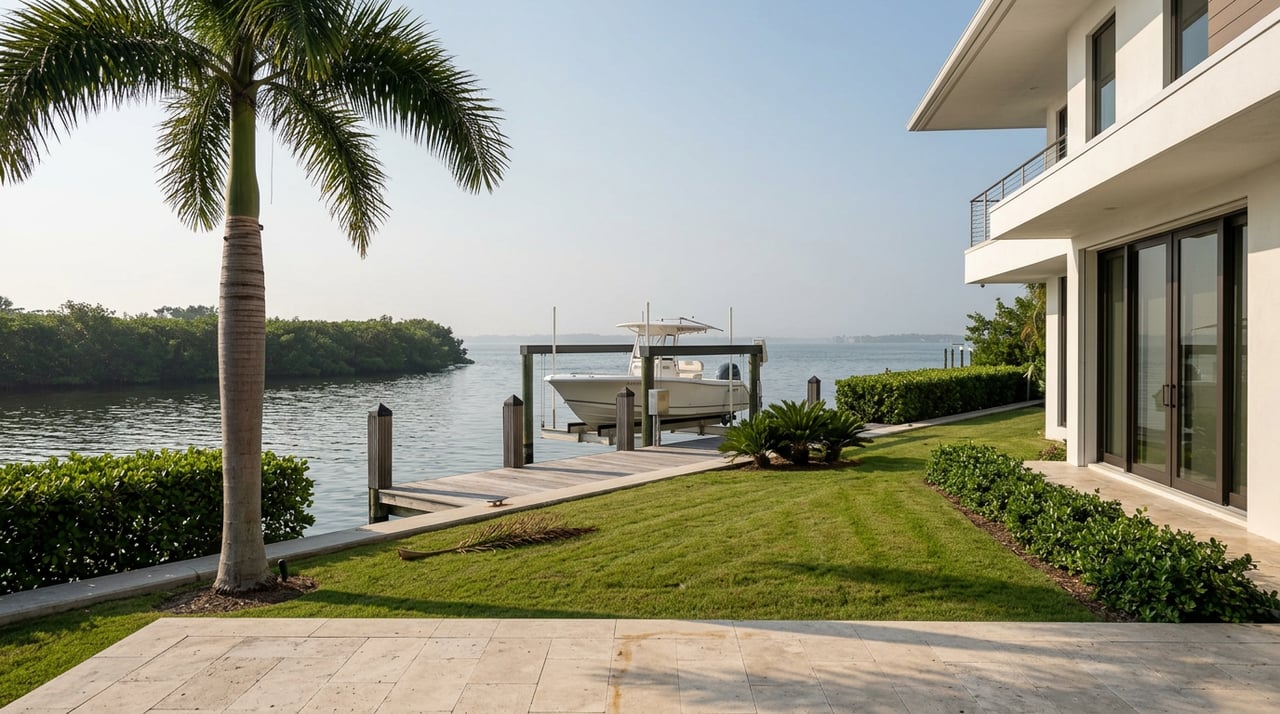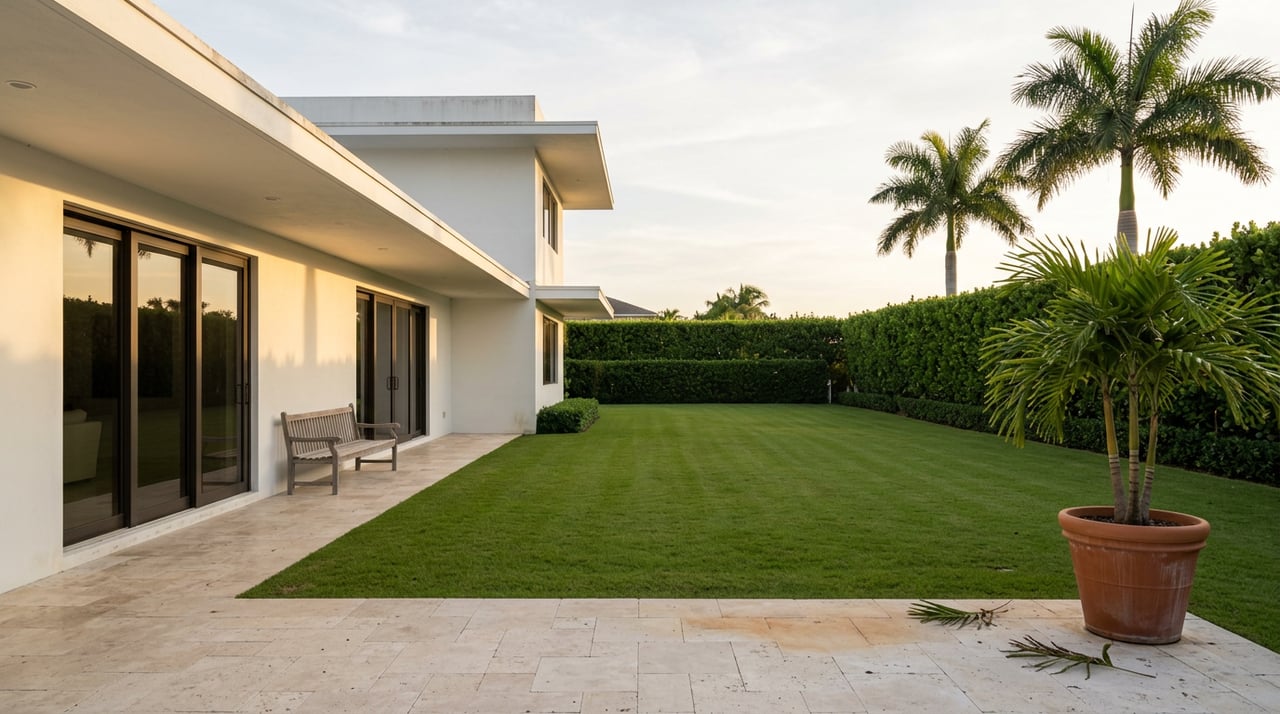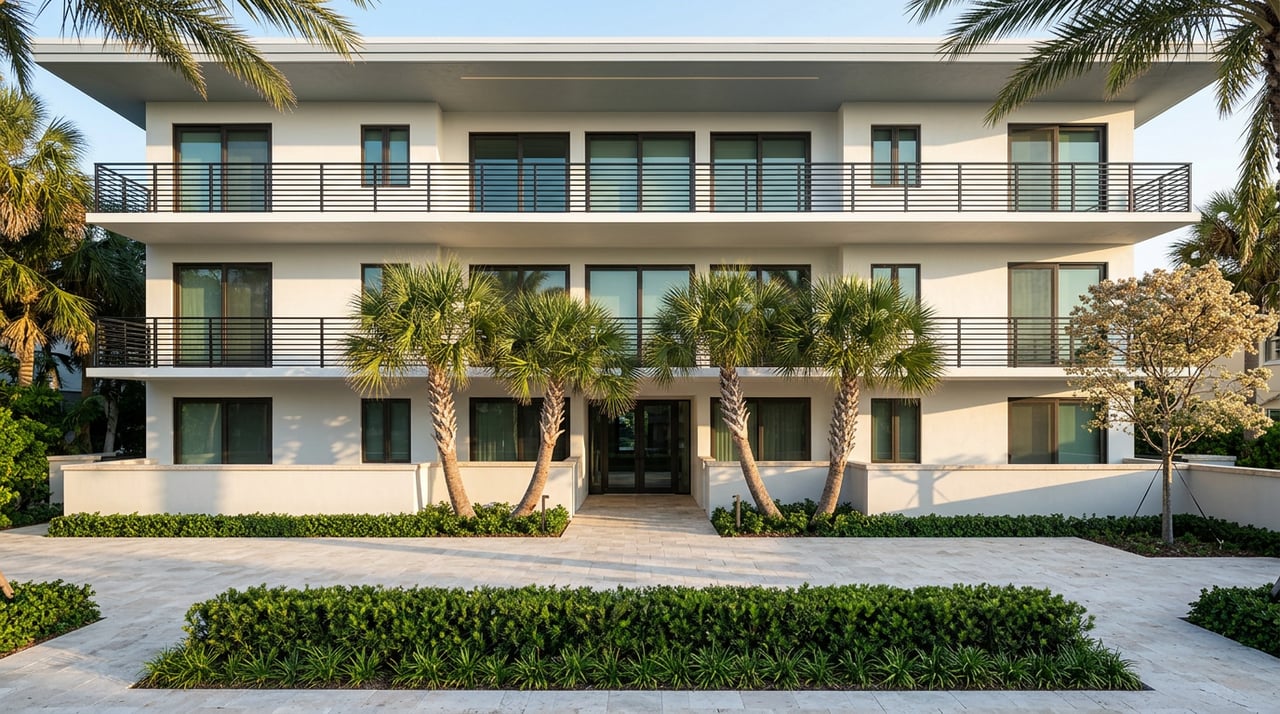
Stand on the sand at Juno Beach Park and look north along A1A. The buildings closest to the water are the ones that have been there the longest: low-slung towers from the 1970s, 80s and 90s with names like Ocean Royale, Sea Oats, Juno Ocean Club, Oak Harbour, 700 Ocean. Now turn around and look west across US Highway 1. That's where Juno Beach's newest luxury address, Caretta, is going up. Ninety-five residences, four low-rise buildings, a rooftop pool with an ocean view. About 400 yards from the sand.
That gap isn't a design choice. It's the market telling you something about what it actually costs to build, insure and someday sell property directly on this stretch of Atlantic coast.
Four Hundred Yards That Aren't an Accident
Caretta, developed by JDL Development and designed by Hartshorne Plunkard Architecture, sits at 1011 US Highway 1 at Donald Ross Road, on the west side of the highway rather than the beach side. It's priced from roughly $1.5 million into the low $4 millions and set to open this year, the first new-construction luxury condominium Juno Beach has seen in years.
A buyer scanning listings might read "steps from the beach" and assume this was simply the best available parcel. It's more specific than that. A true oceanfront site in Juno Beach sits seaward of Florida's Coastal Construction Control Line, a state jurisdictional boundary the Florida Department of Environmental Protection maintains along the Atlantic coast in Palm Beach, Broward and Miami-Dade counties. Anything built seaward of that line, the residence itself, the pool, the seawall, even dune landscaping, needs a separate state permit layered on top of every local approval. Juno Beach's actual beachfront parcels also carry FEMA's VE flood designation, the highest-risk category in the National Flood Insurance Program, reserved for areas exposed to wave action during a major storm.
None of that makes oceanfront construction impossible. It makes it slower, more expensive to insure, and harder to finance at scale. A developer assembling a 5.5-acre site for 95 units has a real incentive to sit one block back, where the regulatory path is simpler and the building can still market itself as beach-adjacent, without carrying the cost structure of true oceanfront.
The Line the State Draws in the Sand
Here's the part that matters for a buyer comparing two Juno Beach addresses rather than one project's site plan: this same line splits the entire local condo market into two products that get talked about as if they're interchangeable and aren't.
| Old and oceanfront | New and one block back | |
|---|---|---|
| Typical building age | 1970s to 1990s | Delivering 2026 |
| Reserve funding | Often underfunded until recently required by law | Fully funded at delivery |
| Milestone inspection exposure | Many buildings are already at or approaching the 30-year threshold | Decades away |
| Regulatory jurisdiction | Seaward of the CCCL, subject to state DEP review for any exterior work | West of US-1, outside CCCL jurisdiction |
| FEMA flood zone | VE, the highest-risk NFIP category | Set back from the highest-velocity wave zone |
The older buildings win on the thing money can't buy back: they're actually on the ocean. The newer building wins on the thing that shows up on a closing statement: funded reserves, current-code construction, and a flood engineering standard written for today's storms rather than the 1980s.
The Bill Nobody Put on the Listing Sheet
Florida law now requires condominium and cooperative buildings three stories or taller to undergo a milestone structural inspection by the year the building turns 30, and every 10 years after that. Roughly 92 percent of Palm Beach County's condominium inventory is over 20 years old, which means a meaningful share of it is either already past that threshold or closing in on it fast.
That statistic lands differently depending on which side of US-1 you're shopping. A unit at 700 Ocean or Sea Oats might show a lower price per square foot than anything at Caretta, and on paper it looks like the better deal. But an older building's next milestone inspection, and the structural integrity reserve study that goes with it, can surface repair costs that get passed to owners as special assessments, sometimes years after closing, sometimes before the ink on the sale is even dry. A buyer running the numbers on an oceanfront unit should ask for the building's most recent reserve study and inspection report before comparing price per square foot to anything at Caretta, because the sticker price on the older unit doesn't include a bill that may already be on its way.
This isn't a knock on any of these buildings. Many have well-run associations and boards that started funding reserves years ago. The point is that the question a buyer needs to ask changes entirely depending on which side of that regulatory line the property sits.
What the Median Is Actually Measuring
Pull the median numbers for Juno Beach and the gap looks almost too large to make sense on its own. Over the trailing three months of June through August 2026, the median Juno Beach house sold for $1,735,000, on nine sales. In August 2026 alone, the median condo or townhouse sold for $462,500, also on nine sales. Reflexively, a buyer reads that spread as square footage: houses are bigger, condos are smaller, of course the number is different.
That's only part of the story. Juno Beach's condo stock spans everything from older, smaller units in buildings approaching their inspection cycle to brand-new construction at Caretta priced well north of a million dollars. The median condo figure is blending two products with almost nothing in common structurally: one carries known, funded reserves and a fresh 40-year runway before its own first milestone inspection, the other may be sitting on deferred maintenance that hasn't been priced into the sale yet.
The days-on-market data tells a similar story from a different angle. As of August 2026, condos and townhouses still listed for sale had sat a median 146 days, while the ones that actually sold had taken a median 153 days to close. A market where actively marketed units move only slightly slower than the ones already sold isn't necessarily a stalled market. It can also be a market where buyers are taking longer to underwrite the building itself, not just the unit, before signing.
None of this means the median is wrong. It means a single number can't tell a buyer whether they're looking at a well-reserved building with two years of oceanfront living ahead of a normal inspection cycle, or one that's about to ask its owners for a six-figure assessment. That distinction has to come from the building's own paperwork, not the price tag.
Questions Worth Asking Before You Compare Two Juno Beach Addresses
Is Caretta actually oceanfront? No. It sits on the west side of US Highway 1 at Donald Ross Road, about 400 yards from the beach, outside the state's Coastal Construction Control Line jurisdiction that governs true oceanfront parcels.
What is the Coastal Construction Control Line, in practical terms? It's a boundary the Florida Department of Environmental Protection maintains along the Atlantic coast. Any construction seaward of it, from a new residence to a seawall to dune landscaping, requires a state permit in addition to whatever the town of Juno Beach already requires.
If I buy an older oceanfront unit, will I definitely face a special assessment? Not automatically. But Florida's milestone inspection law applies to any condominium three stories or taller once the building reaches 30 years of age, with inspections repeating every 10 years after. Given how much of Palm Beach County's condo stock is already over 20 years old, it's worth asking for the specific building's inspection history and reserve study before making an offer, rather than assuming the association has it handled.
Does being one block back from the beach actually change insurance costs? It can. Properties within FEMA's VE flood zone, the designation that applies to Juno Beach's true oceanfront parcels, generally carry the highest wind and flood exposure in the National Flood Insurance Program. A property outside that zone starts from a different baseline, though every policy still depends on the specific structure, elevation and coverage chosen.
Juno Beach is small enough that these two markets sit within walking distance of each other, and different enough that treating them as one conversation does a disservice to anyone trying to make a real decision. Whether the right fit is a fully reserved unit at Caretta or an established building on the sand with its paperwork in order, the details that actually matter here don't show up on a listing sheet. They show up in a reserve study, an inspection report, and a flood determination, read carefully, before an offer goes in.
If you're weighing an oceanfront unit against new construction in Juno Beach, or trying to make sense of what a building's reserve study actually says about its future, Steve Rockoff has spent years working through exactly this kind of due diligence for buyers in Northern Palm Beach County. Schedule a Confidential Consultation to walk through the specific buildings and numbers behind your search.