Jupiter finished a $122 million bridge project this year. The new span over the Loxahatchee River carries U.S. 1 between the town and Tequesta, and it replaced a bridge built in 1958 with narrow two-foot shoulders and no room for a bike or a stroller. The new structure lifts to a vertical clearance of 42 feet and opens onto a 125-foot-wide channel, according to the Florida Department of Transportation's own project page. It is a genuine upgrade to the corridor, and after two and a half years of detours, most of Jupiter noticed.
What almost nobody selling or buying waterfront property in Jupiter has stopped to ask is whether that upgrade touches their address at all. For a meaningful share of the market, it doesn't. A different, much less discussed bridge a short distance away still caps boat height at a fixed 25 feet, with no opening mechanism of any kind. And several smaller spans further up the Loxahatchee's forks sit at 14 feet, 12 feet, even 4.5 feet, fixed, permanent, and unaffected by anything the state just built. If you are comparing two homes that both call themselves Loxahatchee riverfront or Jupiter waterfront, the number that actually separates them was never on the listing sheet.
What the New U.S. 1 Bridge Actually Delivered
The old U.S. 1 span closed on March 13, 2023, and stayed closed for nearly two years while FDOT rebuilt it from the pilings up. The first two lanes reopened in January 2025, full completion was targeted for early 2026, and by this point in the year the project should be finished end to end: two 11-foot travel lanes in each direction, eight-foot sidewalks, seven-foot bike lanes, and a twin double-leaf drawbridge that lifts to 42 feet of clearance over a channel 125 feet wide.
For boat owners, the practical change is fewer waits. A drawbridge doesn't block a vessel the way a fixed span does. It opens on request or on a schedule, and the U.S. 1 bridge operates on demand, but capped at no more than two openings per hour. A boat tall enough to need that opening still has to time its run, radio ahead, and sometimes idle behind another vessel doing the same thing on an outgoing tide. At 42 feet closed, far more boats, including most sportfish with outriggers down and center consoles with hardtops, clear the span without asking it to open at all. That is a real improvement in how often homeowners upstream of this bridge can get to the inlet without planning around a lift schedule.
It is also, notably, an improvement that has nothing to do with the other bridge sitting nearby.
The Fixed Bridge Nobody Rebuilt
A short distance from the new U.S. 1 span, the Alternate A1A bridge crosses the Loxahatchee at a fixed 25 feet, measured at mean high water. It does not open. It was not part of the FDOT project. And by most local accounts there are, in the words of one longtime area agent's own bridge-clearance notes, a large number of homes sitting behind this fixed bridge and the adjacent railroad drawbridge that parallels it. That railroad span carries Florida East Coast Railway and Brightline traffic, and it generally stays open for boats except when a train needs to pass, which adds a second variable to any transit through this stretch.
For a home upstream of the A1A bridge, the state's new U.S. 1 span is irrelevant to the boat behind the dock. The ceiling is still 25 feet, fixed, and it was 25 feet fixed before the U.S. 1 project ever broke ground. A sailboat with a tall mast, or a sportfish with an elevated tuna tower, simply doesn't get past this point regardless of tide, schedule, or how recently the state spent money on infrastructure a few hundred yards away. This is the detail a portal listing rarely surfaces and a buyer touring on a Tuesday afternoon has no way to see: the bridge that matters to your boat may not be the one you drove over to get to the showing.
One Gated Community, Two Different Ceilings
The clearest illustration of this sits inside a single development. The Islands of Jupiter, a gated community of custom homes built in the late 1990s and early 2000s along the Loxahatchee's south fork, is physically split by the Island Way bridge, a fixed span at roughly 12 feet. Homes on the south side of that bridge only have to clear the A1A bridge downstream, at 25 feet, on their way to the inlet. Homes on the north side have to clear both the Island Way bridge and the A1A bridge, meaning a 12-foot ceiling governs what can leave the dock regardless of what the downstream bridge allows.
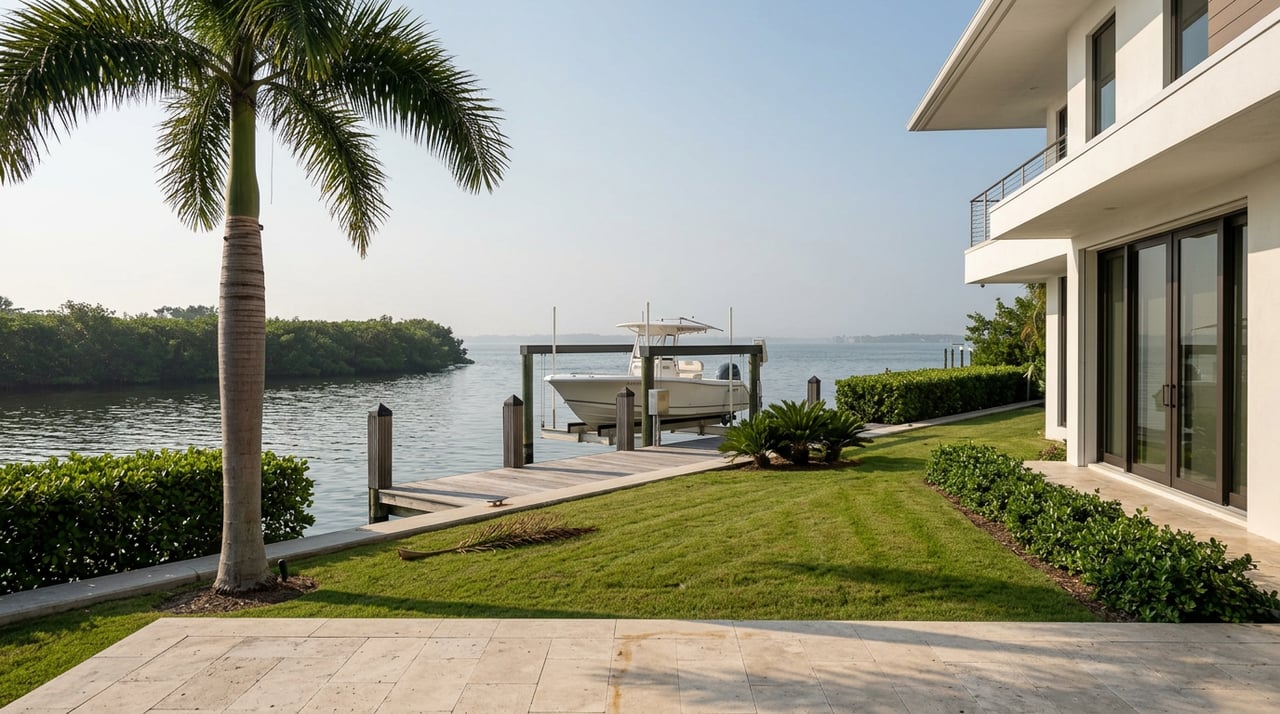
Two homes in the same community, built by the same era of contractors, sharing the same gate code and the same proximity to the restaurants and shops of Jupiter and Tequesta, can support genuinely different boats. A buyer who wants to keep a sportfish with outriggers and a tuna tower needs to know which side of Island Way they're looking at before they fall for the dock in the listing photos. This is not a hypothetical the market handles for you through price. It is a detail that surfaces only if someone asks.
From Kayak to Sportfish: The Range Across Jupiter's Waterways
Local bridge-clearance references, compiled by agents who work this water daily, put the range across Jupiter's connected waterways at roughly this spread, all measured at mean high water:
| Bridge | Waterway | Type | Clearance (MHW) | Schedule |
|---|---|---|---|---|
| Loxahatchee River Road | Southwest Fork | Fixed | ~4.5 ft | None |
| Island Way | South Fork, Islands of Jupiter | Fixed | ~12 ft | None |
| Tequesta Drive | North Fork | Fixed | ~14 ft | None |
| Alternate A1A | Loxahatchee River, near inlet | Fixed | 25 ft | None |
| Bridge Road (SR-708) | Loxahatchee River | Drawbridge | 21 ft closed | On demand |
| Beach Road (Cato's Bridge) | Loxahatchee River | Drawbridge | 25 ft closed | On demand |
| U.S. 1 / SR-5 (new) | Loxahatchee River / ICW | Drawbridge | 42 ft closed | On demand |
At the low end, a fixed 4.5-foot span limits a property to kayaks, paddleboards, and small flats skiffs, the kind of access marketed around community docks and boat ramps rather than private lifts for offshore boats. At the high end, a home downstream of every fixed span and close to the new U.S. 1 bridge can run a serious sportfish to the Jupiter Inlet in minutes without touching a schedule. Between those two ends sits most of Jupiter's waterfront inventory, and the difference between them has far more to do with which bridges a given dock sits behind than with the square footage of the house attached to it.
What This Means When You're Comparing Two Listings
Jupiter's broader market has softened some this year. Realtor.com's April 2026 figures put the town's median listing price at $895,000 with 69 median days on market, and Zillow's tracking shows the average Jupiter home value at $699,018 as of June 2026, down 2.2 percent over the prior twelve months. Countywide, single-family homes carried a median sale price of $645,000 in March 2026, moving through roughly 4.7 months of supply, with sellers receiving about 94.1 percent of original list price. None of that is a dramatic correction, but it is a market with more room to negotiate on specifics than the sprint years of 2021 and 2022, and functional access is exactly the kind of specific that gets negotiated when buyers have time to ask questions instead of racing to offer.
Before comparing two waterfront listings on price alone, it is worth establishing, for each one, every bridge between the dock and the Jupiter Inlet, whether each is fixed or a drawbridge, its closed clearance at mean high water rather than at low tide, and its opening schedule if it has one. A boat's actual clearance needs to be measured with outriggers, antennas, and tuna towers in their normal running position, not folded down for the day, since a folded antenna tells you nothing about the boat's real footprint on a routine trip to the inlet. The same instinct that serves a contract review applies here: the clause that matters is rarely the one printed in bold.
A Few Direct Questions Worth Asking
Does "no fixed bridges" mean no bridges at all? No. It typically means every bridge between the dock and open water is a drawbridge rather than a fixed span, which still leaves opening schedules, tender wait times, and closed clearance as factors worth confirming.
Is a low fixed bridge always a dealbreaker? Not for every buyer. A property behind a 12-foot or 14-foot fixed span can still support a comfortable center console, a pontoon, or a fleet of kayaks. It becomes a dealbreaker only when the buyer's actual boat, mast height and all, doesn't fit underneath it.
Where can this be verified independently? The Jupiter Inlet District publishes boating and navigation information for the local waterways, and FDOT's project page documents the completed U.S. 1 bridge specifications directly. Both are useful starting points before a showing, not after an offer.
Waterfront value in Jupiter has always been a function of what the water actually lets you do, not just what it lets you look at. This year's new bridge changed that answer for some addresses and left it exactly where it was for others. Knowing which side of which bridge a property sits on is the kind of detail that belongs in due diligence, not in a surprise after closing.
If you're comparing Jupiter waterfront properties and want someone who reads the bridge schedule as carefully as the contract, Steve Rockoff is available for a confidential consultation.